
Why Road Markings Lose Reflectivity Within 6 Months | Root Causes Explained
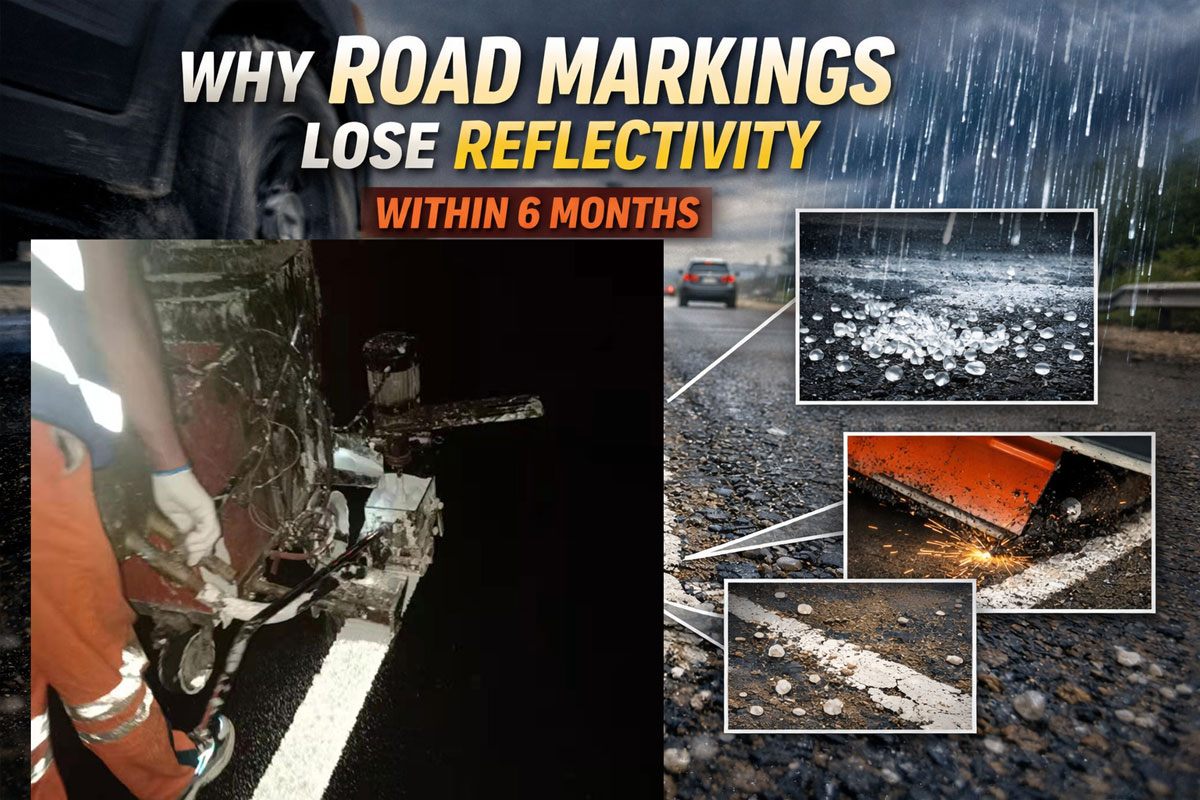
One of the most common complaints from road authorities and contractors worldwide is that newly applied road markings look bright at installation, yet lose night-time reflectivity within just a few months.
This issue is often blamed on traffic volume, weather, or application quality. While these factors play a role, they are rarely the root cause. In most cases, premature reflectivity loss is the result of material design decisions made long before the paint ever reaches the road.
This article explains the real reasons behind rapid reflectivity decay and how it can be prevented.
Understanding Reflectivity in Road Markings
Night-time visibility of road markings depends on retroreflection, which is created when glass beads embedded in the marking return vehicle headlight beams back to the driver.
Two types of glass beads are involved:
- Drop-on glass beads – applied to the surface for immediate brightness
- Intermixed glass beads – blended into the paint for long-term performance
Sustainable reflectivity requires a continuous exposure of new beads as the surface wears. When this mechanism fails, reflectivity drops rapidly.
1. Over-Reliance on Drop-On Glass Beads
Many road markings appear extremely bright immediately after application because large quantities of drop-on glass beads are used.
However, surface beads are the first to be removed by:
- Tire abrasion
- Braking forces
- Rainwater and dust
If intermixed glass bead content is insufficient, there are no new beads to replace those lost at the surface. As a result, reflectivity collapses once the initial layer is worn away — often within 3 to 6 months.
2. Insufficient Intermixed Glass Bead Content
A common cost-saving practice is reducing intermixed bead content to the minimum required to pass laboratory tests.
Typical scenarios include:
- 10% intermixed beads used on high-traffic roads
- No differentiation between urban and highway applications
- Formulations optimized for initial RL values only
In real traffic conditions, such formulations cannot maintain reflectivity over time. For permanent markings, 20–30% intermixed glass beads are generally required.
3. Poor Glass Bead Quality and Gradation
Not all glass beads perform equally, even when standards are nominally met.
Common quality issues include:
- Low roundness or irregular bead shape
- Wide or inconsistent particle size distribution
- Low refractive index beads used for cost reduction
Such beads may provide acceptable initial brightness but fail to sustain retroreflection under wear.
4. Paint Formulation Focused on Paper Compliance
Some thermoplastic paints are designed to meet laboratory thresholds rather than field durability.
Characteristics of these formulations include:
- Binder content reduced to minimum acceptable levels
- Narrow softening point margins
- Limited tolerance for thickness variation
As the binder wears or becomes brittle, beads are released prematurely instead of remaining embedded and exposed gradually.
5. Inadequate Application Thickness
Reflectivity retention depends on the vertical distribution of glass beads within the marking.
When markings are applied too thin:
- Fewer layers of embedded beads exist
- Wear reaches the bead-free zone quickly
- No secondary reflectivity mechanism remains
Thin application often results from attempts to reduce material consumption rather than engineering requirements.
6. Environmental and Traffic Stress Factors
High temperatures, heavy rainfall, dust, and aggressive braking accelerate bead loss.
However, these factors only expose weaknesses in material design — they are rarely the primary cause. Well-designed thermoplastic systems account for environmental stress during formulation.
7. Lack of Retained Reflectivity Requirements
Many specifications focus on initial reflectivity but do not require retained RL values after wear simulation.
Without retained performance criteria:
- Products optimized for short-term appearance dominate procurement
- Lifecycle performance is ignored
- Maintenance costs increase significantly
This gap between specification and real-world performance is a major contributor to premature reflectivity loss.
How to Prevent Reflectivity Loss Within 6 Months
Sustainable reflectivity requires an integrated approach:
- Adequate intermixed glass bead content (typically ≥20%)
- High-quality beads compliant with recognized standards
- Formulations designed with performance margins, not minimum thresholds
- Proper application thickness matched to traffic conditions
Most importantly, procurement decisions should prioritize lifecycle performance rather than initial appearance.
Conclusion
When road markings lose reflectivity within six months, the problem is rarely accidental. It is usually the predictable outcome of cost-driven material design, insufficient bead integration, and specifications that reward short-term compliance.
Understanding these mechanisms allows authorities and contractors to make informed decisions — reducing maintenance cycles, improving safety, and lowering long-term costs.
Durable reflectivity is not achieved by chance. It is engineered.