
How to Identify “Paper-Compliant but Field-Failed” Thermoplastic Road Marking Paint
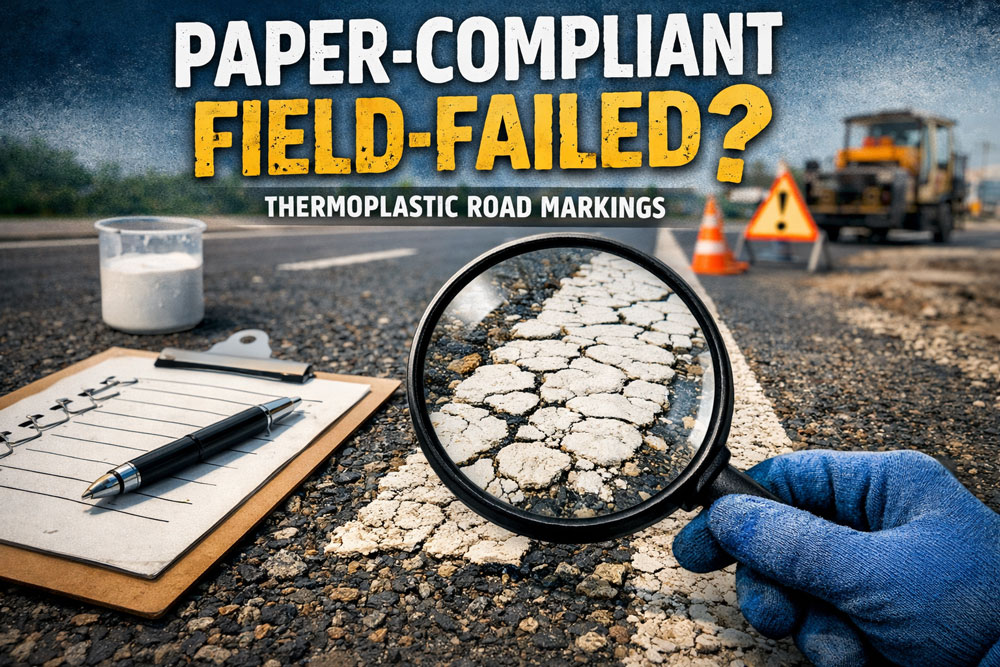
In road marking projects, one of the most frequent and costly problems is the use of materials that appear fully compliant on paper, yet fail prematurely once applied on the road.
Laboratory reports show passing results, certificates are complete, and specifications seem satisfied — but within months, markings lose reflectivity, peel off, crack, or discolor. This is what industry professionals often call “paper-compliant but field-failed” thermoplastic road marking paint.
Understanding why this happens — and how to identify such risks early — is essential for road authorities, consultants, and contractors alike.
Why Laboratory Compliance Does Not Guarantee Field Performance
Most international standards (AASHTO, EN, BS, JT/T, SASO) are based on controlled laboratory conditions:
- Stable temperature and humidity
- Standardized application thickness
- Clean substrates
- Short-term performance indicators
Real roads, however, introduce variables that laboratories cannot fully replicate:
- Contaminated or aged pavement surfaces
- Thickness variation during application
- Heavy axle loads and braking forces
- Extreme heat, rainfall, or seasonal changes
Materials designed only to meet minimum test thresholds often lack sufficient performance margins for real-world conditions.
Common Industry Practices That Create “Paper Compliance”
1. Designing Formulations at the Minimum Threshold
Some manufacturers formulate products to sit just above the standard limits:
- Softening point barely meeting requirements
- Minimum resin content
- Lowest acceptable glass bead percentage
While these products pass laboratory testing, even minor deviations during application can lead to early failure.
2. Test Samples Do Not Represent Mass Production
A frequent but rarely discussed issue is inconsistency between tested samples and supplied batches:
- Higher-grade raw materials used for test samples
- Cost-reduced formulations used for bulk delivery
- No batch traceability or consistency control
Certificates remain valid, but field performance deteriorates.
3. Relying on Drop-On Glass Beads for Short-Term Brightness
Some products achieve impressive initial reflectivity by applying large quantities of drop-on glass beads.
However, if intermixed glass bead content is insufficient, reflectivity drops sharply once surface beads wear away.
Warning Signs Hidden in Technical Data Sheets
1. Focus on Initial Values Only
Be cautious when documentation emphasizes:
- Initial luminance or RL values only
- No retained reflectivity data
- No abrasion or wear simulation results
Field durability depends on retained performance, not initial brightness.
2. Unclear Glass Bead Specifications
If a supplier cannot clearly state:
- Exact intermixed bead percentage (10%, 20%, 30%)
- Applicable bead standard (AASHTO M247, EN 1423, BS, SASO)
- Bead gradation and roundness control
The formulation is likely optimized for cost rather than durability.
3. Extremely Narrow Application Temperature Window
Paints that barely meet softening point requirements often:
- Require precise heating control
- Exhibit flow instability on site
- Fail under minor temperature deviations
Such sensitivity increases the risk of inconsistent field results.
Practical On-Site Methods to Detect Problematic Materials
1. Observe the Melt Behavior
High-quality thermoplastic paint should:
- Melt uniformly
- Maintain stable viscosity
- Show no visible separation
Signs of poor formulation include clumping, segregation, or burnt odors.
2. Inspect Edges After Cooling
After cooling, markings should:
- Have clean, well-defined edges
- Resist manual peeling
- Show no powdering or brittleness
Fragile or chalky edges often indicate insufficient binder content.
3. Simple Abrasion Observation
Light surface abrasion should reveal new glass beads embedded within the marking.
If no additional beads appear, intermixed bead content is likely inadequate for long-term performance.
Three Critical Questions to Ask Before Procurement
- Is this formulation designed to pass tests, or to survive real traffic conditions?
- Can the supplier provide references using the same formulation and batch controls?
- Is the formulation adjustable for climate, traffic volume, or service life requirements?
Experienced suppliers are willing to discuss failure scenarios — not only success cases.
Conclusion: Compliance Is Only the Starting Point
Road marking paint is not a laboratory product; it is an engineering material exposed to extreme conditions every day.
Reliable thermoplastic systems are characterized by:
- Performance margins beyond minimum standards
- Consistency between tested and supplied batches
- Stable behavior under variable site conditions
Identifying “paper-compliant but field-failed” materials is ultimately about distinguishing between products designed to satisfy documentation and those designed to protect road users over time.