
Low-Cost Thermoplastic Paint: The Hidden Lifecycle Costs
In road marking procurement, thermoplastic paint is often compared by price per ton. On paper, the lowest-priced option may appear to offer immediate savings. In practice, however, low-cost thermoplastic paint frequently leads to higher total expenditure over the life of the marking.
This article explains why “cheap” thermoplastic paint often becomes the most expensive option once durability, maintenance, traffic disruption, and safety are taken into account.
The Difference Between Purchase Price and Lifecycle Cost
The purchase price of thermoplastic paint represents only a small fraction of the total cost of a road marking system. Lifecycle cost includes:
- Material consumption
- Application labor and equipment
- Traffic control and lane closures
- Inspection and rework
- Accident risk due to reduced visibility
Low-cost materials often reduce the first item on this list, while significantly increasing all others.
How Low-Cost Thermoplastic Paint Is Achieved
To reduce unit price, manufacturers may apply several cost-cutting measures:
- Lower resin content
- Reduced intermixed glass bead percentage
- Use of lower-grade fillers
- Minimal performance margins above standard limits
While these formulations can still pass laboratory testing, their ability to withstand real traffic conditions is limited.
Hidden Cost #1: Shortened Service Life
One of the most immediate consequences of low-cost thermoplastic paint is reduced durability.
Common symptoms include:
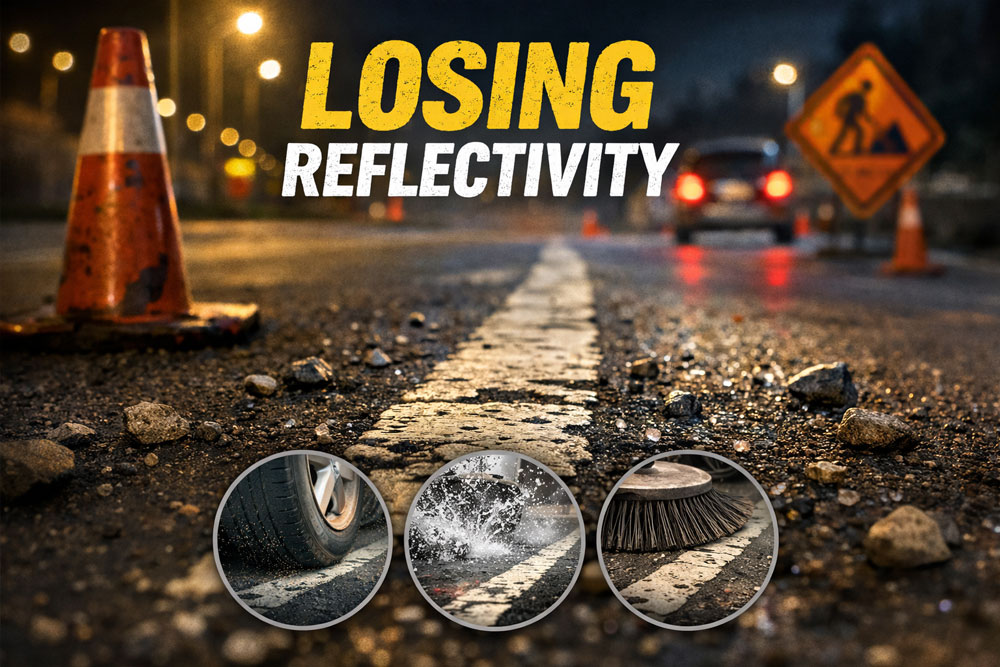
- Early loss of reflectivity
- Surface abrasion within months
- Cracking or brittleness under temperature changes
Markings that require repainting every 6–12 months quickly eliminate any initial savings.
Hidden Cost #2: Increased Maintenance Frequency
Each repainting cycle involves more than just material:
- Mobilization of crews and equipment
- Traffic management and safety measures
- Night work premiums in urban areas
In many regions, maintenance costs exceed the original material cost within the first year.
Hidden Cost #3: Traffic Disruption and User Delay
Frequent maintenance increases lane closures and traffic disruption.
These impacts are often excluded from procurement calculations, yet they represent real economic costs:
- Congestion and delays
- Increased fuel consumption
- Higher accident risk in work zones
From a public authority perspective, these indirect costs can far exceed material savings.
Hidden Cost #4: Loss of Night-Time Safety
Low-cost formulations often prioritize initial appearance over retained performance.
When reflectivity drops rapidly:
- Lane guidance becomes unclear at night
- Wet-weather visibility is compromised
- Accident risk increases, especially at intersections
Safety-related costs are difficult to quantify, but their consequences are severe.
Hidden Cost #5: Inspection Failures and Rework
Markings that degrade quickly may fail:
- Warranty inspections
- Retained reflectivity requirements
- Performance-based contracts
Rework under traffic often costs significantly more than initial installation.
Lifecycle Cost Comparison: Low-Cost vs Engineered Thermoplastic
| Cost Element | Low-Cost Thermoplastic | Engineered Thermoplastic |
| Initial Material Cost | Low | Moderate |
| Service Life | 6–12 months | 24–36 months or longer |
| Maintenance Frequency | High | Low |
| Traffic Disruption | Frequent | Minimal |
| Total Lifecycle Cost | High | Lower over time |
Why Lifecycle Cost Is Often Ignored
Procurement processes often emphasize:
- Lowest bid selection
- Initial compliance documentation
- Short-term budget constraints
Without lifecycle evaluation criteria, suppliers are incentivized to optimize for price rather than performance.
How to Avoid the Low-Cost Trap
Authorities and contractors can reduce long-term costs by:
- Specifying minimum service life expectations
- Requiring retained reflectivity values
- Evaluating intermixed glass bead content
- Considering maintenance and traffic control costs
A slightly higher material price often delivers substantial savings over the life of the project.
Conclusion
Low-cost thermoplastic paint is rarely low-cost in the long run.
When durability, maintenance, traffic disruption, and safety are considered, engineered thermoplastic systems consistently deliver better value.
The true measure of cost is not what is paid at delivery, but what is paid over time.