
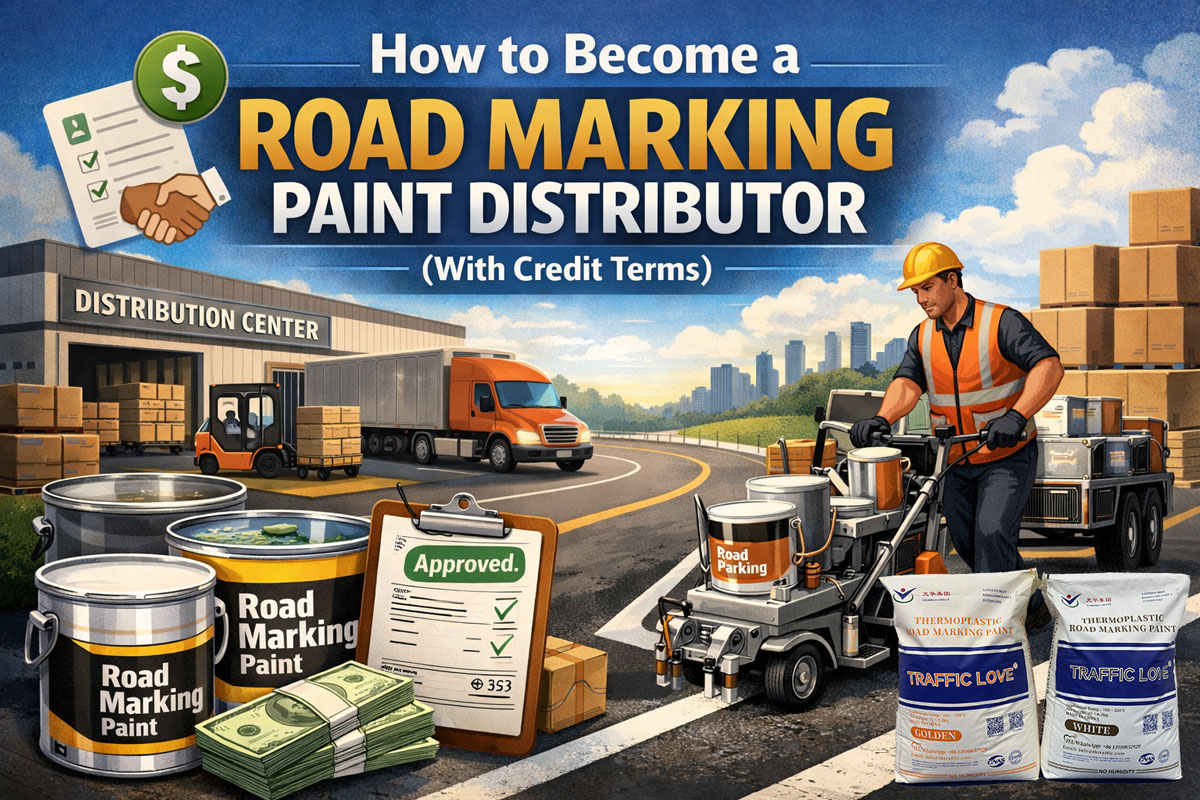
How to Become a Road Marking Paint Distributor (With Credit Terms)
The global demand for durable and compliant road marking materials continues to grow, driven by infrastructure investment, urban expansion, and stricter road safety regulations. For many local companies, becoming a road marking paint distributor is not only a trading opportunity, but a long-term position in public infrastructure supply chains.
This guide explains what it really means to become a professional distributor — beyond simply reselling paint — and how credit-based cooperation can be structured sustainably.
Who Is a Road Marking Paint Distributor?
A road marking paint distributor is more than a reseller. In most markets, distributors serve as the local technical, logistical, and commercial interface between manufacturers and road authorities or contractors.
Typical distributor responsibilities include:
- Local sales and tender participation
- Technical clarification and specification support
- Stockholding or call-off supply
- After-sales coordination and complaint handling
For large infrastructure projects, distributors are often treated as part of the supply chain, not external vendors.
Why Manufacturers Work with Distributors Instead of Direct Sales
In many countries, road marking materials are purchased through:
- Government-approved supplier lists
- Local contractor frameworks
- Pre-qualified tender systems
Local distributors provide market access that overseas manufacturers cannot easily replicate. They understand procurement rules, approval processes, and project payment cycles.
For this reason, serious manufacturers prioritize long-term distributor partnerships over one-off exports.
Basic Qualifications to Become a Distributor
While requirements vary by region, qualified distributors typically demonstrate:
- Experience in road construction or traffic safety products
- Existing relationships with contractors or authorities
- Ability to handle local compliance and registration
- Basic technical understanding of road marking materials
Financial stability and operational transparency are more important than company size. In many cases, mid-sized local firms outperform larger trading companies.
Understanding Credit Terms in Road Marking Paint Supply
Credit terms are a critical factor for distributors, especially in markets where project payments are delayed.
Responsible manufacturers may offer:
- Shipment-first models for repeat partners
- 30–90 day credit terms depending on volume and track record
- Flexible payment structures aligned with project milestones
Credit is not based on promises — it is built through consistent performance, communication, and mutual risk control.
How Credit-Based Cooperation Is Evaluated
Before extending credit terms, manufacturers typically assess:
- Past cooperation or trial orders
- Local customer base and project visibility
- Payment history and financial discipline
- Inventory management and sales forecasting
Credit limits usually increase gradually, aligned with real sales performance rather than theoretical potential.
OEM and Private Label Opportunities
Many distributors prefer to build their own brand while relying on an experienced manufacturer. OEM cooperation allows:
- Customized formulations for local climate and standards
- Private labeling and packaging design
- Exclusive market or project-based protection
OEM road marking paint is common in markets where local registration or branding is required for public tenders.
Factory Price Advantage and Supply Stability
Direct cooperation with a manufacturing group provides distributors with:
- Factory-level pricing without trading layers
- Stable raw material sourcing
- Consistent batch quality and traceability
In large projects, price stability and delivery reliability are often more important than short-term discounts.
Joint Venture and Local Manufacturing Options
For high-volume markets, some distributors evolve into manufacturing partners. Joint venture models may include:
- Local production lines using imported raw materials
- Shared investment in equipment and technical teams
- Reduced logistics cost and faster delivery
This approach is increasingly common in Africa, the Middle East, and Southeast Asia.
What Long-Term Distributors Value Most
Successful distributor relationships are built on:
- Technical transparency
- Stable quality over time
- Clear communication on lead times and risks
- Support during inspections and disputes
Road marking projects carry public responsibility. Distributors choose manufacturers who protect their reputation, not just their margin.
Conclusion
Becoming a road marking paint distributor is not about buying cheap products. It is about entering a long-term infrastructure supply relationship.
With the right manufacturer, structured credit terms, and technical support, distributors can grow alongside national road development — project by project.