
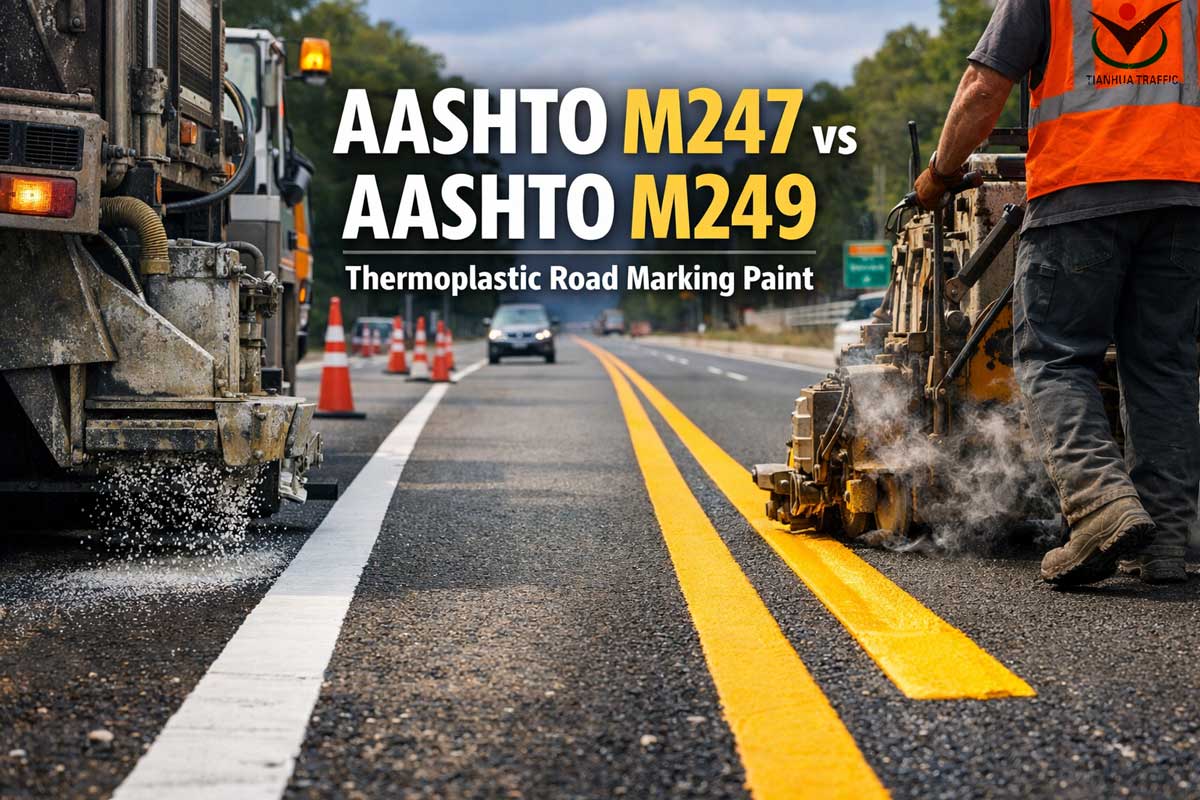
AASHTO M247 vs AASHTO M249 Thermoplastic Road Marking Paint — Standards, Applications, and Why Governments Use Them
In modern highway and high-speed road infrastructure, road marking performance is evaluated according to international standards that define both material characteristics and expected behavior under traffic and environmental exposure. Among these, two of the most referenced specifications from the American Association of State Highway and Transportation Officials (AASHTO) are AASHTO M247 and AASHTO M249.
Although both standards apply to road marking systems, they serve very different roles in material selection and performance verification. Understanding this distinction — and how it translates into real project outcomes — is critical for government procurement, engineering firms, and contractors.
What AASHTO M247 Is — Reflective Glass Bead Performance
AASHTO M247 is a glass bead specification used to evaluate retroreflective performance of road markings. It is not a “road marking paint specification” per se, but a performance standard for the **glass beads embedded in or applied to marking materials**.
The rationale is straightforward: Visibility at night depends on how well the beads return headlight energy to drivers. M247 defines categories that specify bead refractive index, roundness, and durability — all of which directly affect:
- Initial retroreflectivity of the marking
- Retained retroreflectivity after wear
- Uniformity under real traffic conditions
Without bead systems meeting M247 criteria, a thermoplastic paint — no matter how well formulated — cannot achieve sustained night visibility. Governments specify this standard because it places quantitative control points on a core safety function.
What AASHTO M249 Is — Thermoplastic Road Marking Material
AASHTO M249 is the material specification for thermoplastic pavement marking. It defines a comprehensive set of requirements for the raw material system itself — not just reflectivity — including:
- Binder and polymer performance
- Softening point and heat stability
- Wear resistance under simulated load
- Compatibility with glass beads (such as those tested by M247)
- Visual characteristics (color, contrast)
Unlike AASHTO M247 (which focuses only on glass beads), M249 addresses the whole material chemistry and behavior of the thermoplastic marking paint once it is heated, applied, cooled, and exposed to traffic.
In highway projects — especially those with heavy truck loads and high temperatures — M249 provides the engineering framework to ensure that the road marking material itself is durable and performs as a safety-critical element of the pavement.
Key Differences at a Glance
| Aspect | AASHTO M247 | AASHTO M249 |
|---|---|---|
| Focus | Glass bead performance for retroreflectivity | Thermoplastic road marking material performance |
| Core Domain | Reflective bead quality | Paint chemistry and physical behavior |
| Controls | Refractive index, roundness, wear characteristics of beads | Binder softening point, wear resistance, bead compatibility |
| Application | Part of marking system measurement (retroreflectivity) | Full marking material specification (durability + application) |
| Government Use | Night visibility criteria | Highway material approval and procurement standard |
Why Governments Specify These Standards
Public infrastructure investment requires accountability, transparency, safety, and long-term value. Standards like AASHTO M247 and M249 are chosen because they:
- Provide measurable performance criteria rather than vague descriptions
- Align with accident reduction and night visibility goals
- Support international consistency across agencies and contractors
For highway authority procurement, specifying M249 ensures that the material delivered is engineered to handle real traffic loading, temperature cycles, and maintenance requirements over its specified service life.
M247 is embedded into the acceptance process because retroreflectivity is a direct safety metric — and beads that meet M247 criteria are far more likely to retain visibility over time.
What “True AASHTO Compliance” Means in Practice
It is one thing to cite a standard in a product label, and quite another to **demonstrate engineering compliance via raw materials, formulation, and field performance**.
In many markets — including China — it is common to see road marking paints labeled with “AASHTO compliance” without real evidence that the material system satisfies the underlying performance logic of the standards. This can mislead procurement officers and engineers, leading to:
- Products that pass individual tests but fail in service
- Beads that meet M247 lab values but are not integrated properly
- Paints that shrink, crack, or wear prematurely
This is not a fault of the standards — it is a fault of supply chain and formulation discipline.
How Engineering-Level Manufacturers Really Meet AASHTO Standards
To truly deliver M247 + M249 compliant thermoplastic road marking paint, a manufacturer must build performance from the ground up:
1. Factory-Controlled Raw Material Systems
AASHTO M249 specifies behaviors of the paint matrix: but if the resin supplier, filler lots, or glass bead supplier vary from batch to batch, the performance readout will vary too. Engineering compliance means:
- Fixed, certified resin suppliers
- Traceable filler and pigment lots
- Glass beads that meet M247 criteria consistently
2. Project-Based Formulation
Different climates, traffic speeds, and pavement surfaces demand:
- Different softening point ranges
- Different bead embedment profiles
- Different wear resistance balances
A generic formula that “works somewhere” is not enough for government infrastructure — it must be tuned to the project context while still satisfying both M247 and M249 performance logic.
3. Integrated QC and Lifecycle Focus
True compliance means going beyond “lab certificates”:
- Incoming material verification
- In-process property control
- Finished material batch traceability
- Field verification of retained reflectivity and wear
Tianhua Traffic Group: Engineered AASHTO Compliance
Tianhua Traffic Group is one of the few manufacturers capable of delivering thermoplastic road marking paint that genuinely satisfies the intent and performance requirements of both AASHTO M247 and M249:
- Thermoplastic formulations designed from certified raw materials
- Glass bead systems aligned with M247 performance categories
- Thermoplastic paint matrix engineered for softening point, wear resistance, and durability under M249 logic
- QC systems tracking consistency from raw input to finished batch
In contrast to products that merely claim AASHTO compliance on a label, Tianhua’s approach ensures:
- Real retained reflectivity over service life
- Stable adhesion and reduced repaint cycles
- Performance under high traffic and temperature conditions
Summary — Beyond Paper Compliance
AASHTO M247 and M249 are not arbitrary codes — they encode deep performance expectations for highway marking systems. Governments choose them because they translate into safer, more durable highway markings that deliver measurable value over infrastructure lifecycles.
Compliance is not about copying a standard number into a product sheet; it is about building product systems — from raw materials through formulation and production — that truly satisfy the performance logic of the standards.
For highway marking projects where safety, durability, and lifecycle cost matter, selecting an engineered supplier such as Tianhua Traffic Group makes the difference between paper compliance and field performance.