
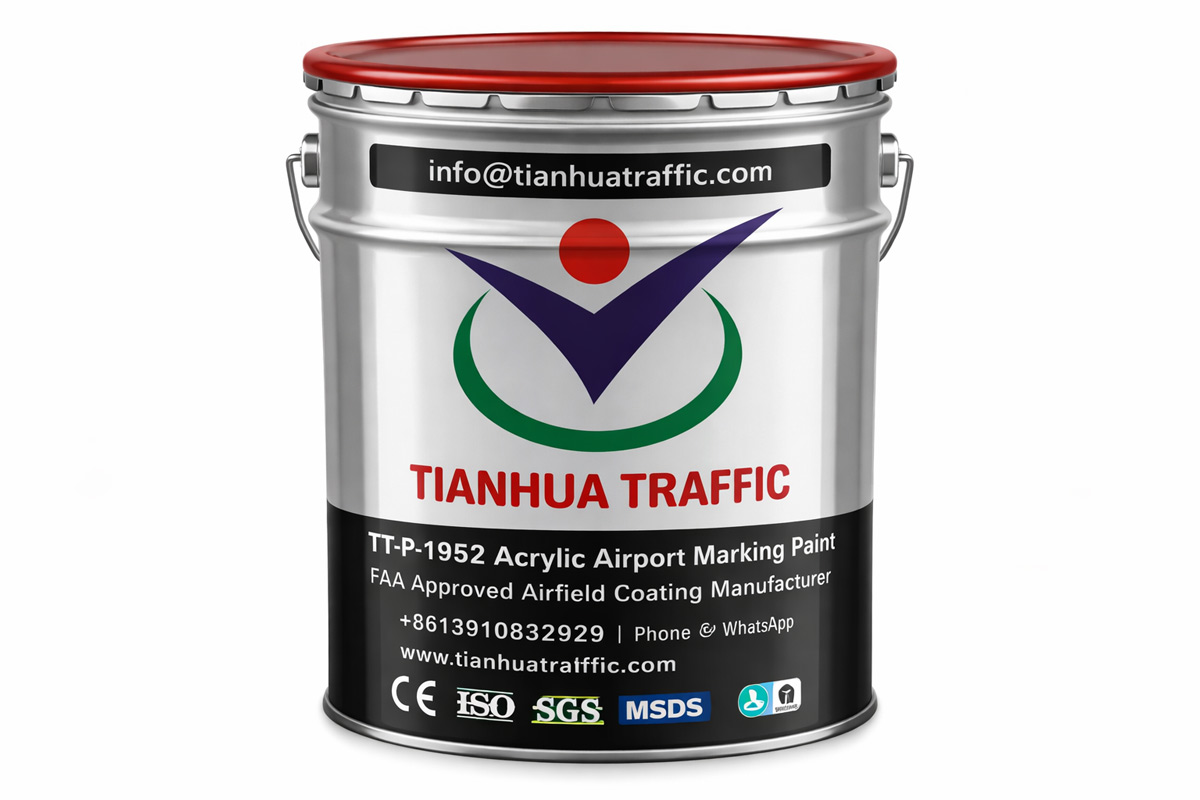
TT-P-1952 Acrylic Airport Marking Paint | FAA Approved Airfield Coating Manufacturer
In modern aviation infrastructure, airfield marking performance is not optional. Runways, taxiways, aprons, and holding positions rely on precise visual guidance under extreme operational conditions.
That is why the Federal Aviation Administration (FAA) specifies TT-P-1952 as the core technical standard for acrylic airport marking paint used on U.S. and FAA-compliant international airports.
This article provides a deep, technical-marketing analysis of TT-P-1952: what it is, why it exists, how real performance is evaluated, and what separates compliant products from truly reliable manufacturers.
What Is TT-P-1952?
TT-P-1952 is a U.S. federal specification defining performance, formulation, and testing requirements for waterborne and solvent-based acrylic airfield marking paints.
It is widely referenced in:
- FAA Advisory Circulars (AC 150 series)
- ICAO-aligned international airport projects
- Military and civil joint-use airfields
- Overseas airports built or upgraded under FAA guidance
In simple terms: if an airport follows FAA marking philosophy, TT-P-1952 is the paint baseline.
Why FAA Uses Acrylic Paint for Airports
Airport markings operate under conditions far more severe than highways:
- Jet blast and high shear forces
- Fuel, hydraulic oil, and rubber contamination
- Rapid temperature changes
- Strict visibility requirements day and night
Acrylic systems defined by TT-P-1952 offer a balance that few coatings achieve:
- Fast drying to minimize runway closure time
- High color stability (white, yellow, red)
- Strong adhesion to concrete and asphalt
- Compatibility with reflective glass beads
This is not decorative paint — it is operational safety equipment.
TT-P-1952 Types and Classifications
By Application Method
- Type I – Standard acrylic marking paint
- Type II – Reflective paint with drop-on glass beads
By Formulation
- Waterborne acrylic (environmentally preferred)
- Solvent-based acrylic (special conditions)
Each type must meet strict laboratory and field performance benchmarks.
Key Performance Requirements Under TT-P-1952
Color and Visibility Stability
FAA markings must remain clearly visible under:
- Strong sunlight and UV exposure
- Night lighting and wet conditions
- High contrast against pavement surfaces
TT-P-1952 strictly controls:
- Initial color values
- Color retention after weathering
- No excessive yellowing or fading
Drying Time and Operational Efficiency
Runway downtime is extremely costly.
TT-P-1952 acrylic paint is engineered for:
- Rapid surface drying
- Early resistance to tire pickup
- Quick reopening to aircraft traffic
This performance is only achievable with controlled acrylic polymer systems — not low-grade emulsions.
Adhesion and Durability
The specification includes rigorous testing for:
- Adhesion to asphalt and Portland cement concrete
- Resistance to peeling and flaking
- Wear under simulated traffic
Passing initial adhesion is not enough — long-term bond stability is the true challenge.
Reflectivity with Glass Beads
Night-time guidance depends on retroreflection.
TT-P-1952 requires:
- Proper bead embedment depth
- Uniform bead distribution
- Durable bead retention after traffic
Paint viscosity, film thickness, and curing behavior must be precisely engineered to achieve this.
Why Many “Approved” Paints Fail in Real Airports
A common industry issue: passing laboratory approval does not guarantee field performance.
Common failure reasons include:
- Batch-to-batch formulation inconsistency
- Cost-driven resin substitution
- Poor compatibility with local glass beads
- Lack of project-specific adjustment
Airports then face premature repainting, increased closures, and safety risks.
What a Reliable TT-P-1952 Manufacturer Does Differently
Industrial Acrylic Polymer Control
True manufacturers control:
- Acrylic resin molecular weight range
- Film-forming temperature behavior
- Weathering resistance additives
This ensures consistent curing and long-term durability.
System-Based Quality Control
Beyond final inspection, reliable factories implement:
- Incoming raw material verification
- In-process viscosity and solids control
- Batch traceability linked to production date
Project-Oriented Technical Support
Airfield environments differ widely.
Professional suppliers provide:
- Application guidance by temperature and humidity
- Compatibility advice for local beads and equipment
- Documentation aligned with FAA inspection logic
Tianhua Traffic Group – FAA-Oriented Airport Marking Solutions
Tianhua Traffic Group supplies TT-P-1952 compliant acrylic airport marking paint for international airfield projects that follow FAA and ICAO guidance.
Manufacturing Depth, Not Trading
- Controlled acrylic resin systems
- Stable batch-to-batch performance
- Dedicated production lines for airfield coatings
International Project Experience
Tianhua supports airport projects in:
- Middle East
- Africa
- Southeast Asia
Where FAA specifications are adopted as performance benchmarks.
OEM and Authority-Focused Supply
Support includes:
- OEM labeling and documentation
- Technical data sheets aligned to TT-P-1952
- Factory pricing for long-term supply programs
TT-P-1952 Is Not Just a Paint Specification
TT-P-1952 represents a philosophy:
- Safety before cost
- Performance before appearance
- System control over shortcuts
For airports where operational reliability matters, choosing the right TT-P-1952 manufacturer is as critical as choosing the standard itself.
To discuss FAA-compliant acrylic airport marking paint solutions tailored to your project, Tianhua Traffic Group welcomes technical consultation.