
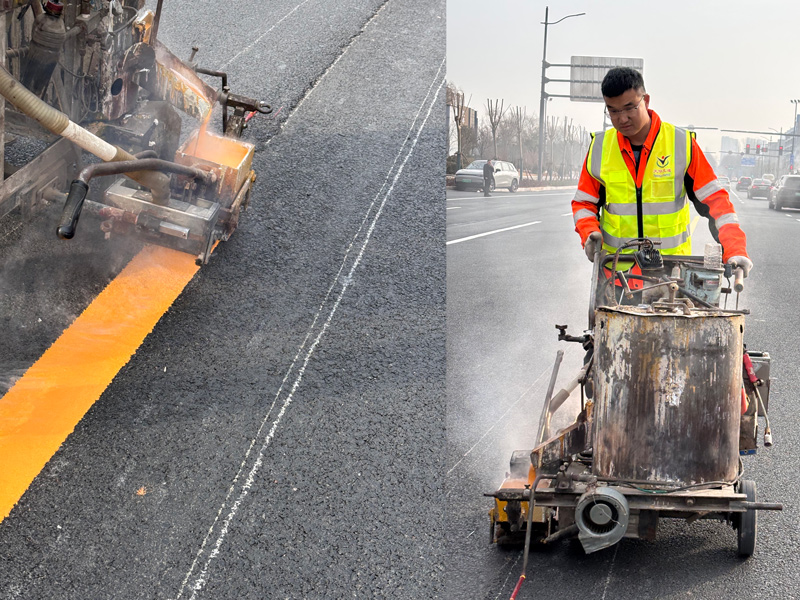
Thermoplastic Road Marking Paint for Infrastructure Projects | Bulk Supply for Southeast Asia
Large infrastructure projects require more than just large quantities of road marking materials. Contractors and project procurement teams often need hundreds of tons of thermoplastic road marking paint and reflective glass beads delivered on schedule while meeting strict technical standards.
However, many procurement discussions start with a simple question: “What is the price per ton?” In reality, price alone rarely determines whether road marking materials will perform successfully on a highway or city road.
Before a reliable quotation can be prepared, several critical technical details must be confirmed. These details determine not only the price but also the long-term durability, reflectivity, and compliance with government inspection requirements.
Why Infrastructure Projects Require Precise Specifications
A typical highway or national road project may require large volumes of materials such as:
- Thermoplastic Road Marking Paint – White
- Thermoplastic Road Marking Paint – Yellow
- Reflective Glass Beads
For example, a single project may involve over 150 tons of thermoplastic paint and more than 15 tons of glass beads. At this scale, even small differences in formulation or materials can significantly affect road marking performance.
If the paint formulation does not match the project specification, road markings may fade quickly, lose reflectivity, or fail inspection during project acceptance.
Understanding Thermoplastic Road Marking Paint Standards
Thermoplastic road marking paint used in international projects is usually produced according to established standards or project specifications. The most commonly referenced standards include:
- AASHTO standards used in many international highway projects
- BS specifications widely used in Commonwealth countries
- Project-specific specifications issued by government authorities
Each specification defines requirements such as binder composition, softening point, pigment content, and glass bead compatibility. A professional manufacturer must evaluate these parameters before production begins.
Application Method Determines the Paint Formula
Another important factor is how the thermoplastic road marking paint will be applied on site. Different road marking machines require different formulations.
- Screed Application – Common for thick and durable road lines
- Spray Application – Used for thinner markings and high-speed installation
- Extrusion Application – Used for structured or heavy-duty markings
Each method requires specific viscosity and melting characteristics. If the paint is not formulated for the correct application method, contractors may experience uneven lines, poor bonding, or premature wear.
The Role of Glass Beads in Night Visibility
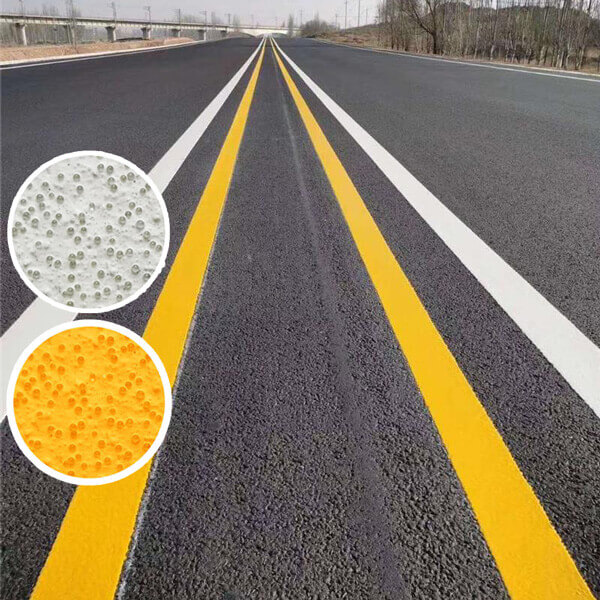
Reflective glass beads are essential for ensuring that road markings remain visible to drivers at night. In thermoplastic road marking systems, two types of glass bead applications are commonly used.
- Premix Glass Beads – Mixed inside the thermoplastic paint to maintain reflectivity as the marking wears
- Drop-On Glass Beads – Applied onto the surface during installation for immediate nighttime visibility
The correct balance between premix and drop-on glass beads is critical for achieving long-lasting retroreflectivity and meeting road authority requirements.
Logistics Planning for Bulk Road Marking Materials
Large infrastructure projects also require careful logistics coordination. Thermoplastic road marking paint is typically shipped in palletized bags or cartons inside containers, and reflective glass beads require protective packaging to avoid moisture during transportation.
Confirming the destination port early in the procurement process allows manufacturers to prepare accurate shipping plans and ensure timely delivery for project schedules.
Why Contractors Work with Experienced Manufacturers
For contractors involved in highway construction and large road projects, working with an experienced manufacturer can significantly reduce procurement risks.
Manufacturers with international project experience can help verify specifications, recommend suitable formulations, and coordinate production schedules with project timelines.
Tianhua Group is a manufacturer specializing in thermoplastic road marking paint and reflective glass beads. The company supplies road marking materials for infrastructure projects in Asia, the Middle East, Africa, and other international markets.
With large-scale production capacity and strict raw material control, Tianhua provides stable batch-to-batch quality and project-specific formulations designed for different climates, road conditions, and technical standards.
Preparing for Your Next Road Marking Project
If you are sourcing thermoplastic road marking materials for a project in Cambodia or other Southeast Asian countries, preparing the following information will help manufacturers provide an accurate quotation and technical proposal:
- Required technical standard or project specification
- Road marking application method
- Glass bead type (premix or drop-on)
- Project location and destination port
Providing these details allows manufacturers to recommend the most suitable thermoplastic paint formulation and ensure that the road markings deliver long-term performance under real traffic conditions.