
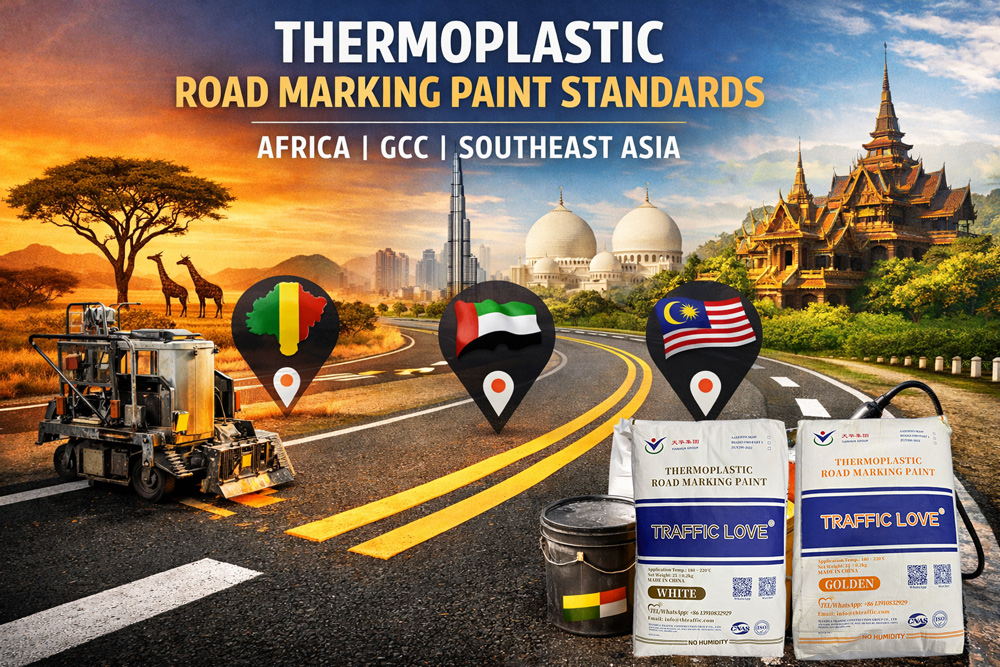
Thermoplastic Road Marking Paint Standards by Country | Africa, GCC & Southeast Asia Certification Guide
Executive Summary
In Africa, Middle East (GCC) and Southeast Asia, most countries lack dedicated national certification schemes for thermoplastic road marking paints. Generally, road authorities rely on performance specifications or international standards.
Notable exceptions include South Africa and Saudi Arabia, where structured frameworks exist. In most other markets, road agencies issue technical requirements directly through project contracts.
This article provides a country-by-country breakdown of:
- Regulatory authorities
- Standards and specifications
- Certification requirements
- Testing criteria
- Approval processes
Africa
South Africa – SANRAL / SABS
No official thermoplastic paint standard exists. SANRAL and major cities use European standards such as EN 1790 / EN 1871 in contracts.
- Key criteria: retroreflectivity (RL/Qd), skid resistance, colour, durability
- No mandatory certification
- Approval based on laboratory test reports
Egypt – Public Works Authority / EOS
Uses Egyptian Standards (EOS) or project specifications. No dedicated thermoplastic standard identified.
- No mandatory certification
- Approval through technical compliance and lab reports
Nigeria – SON
No specific thermoplastic marking standard. General paint standards may apply.
- No mandatory certification
- Relies on ASTM / AASHTO references
Kenya – KEBS / Road Authorities
No specific standard for thermoplastic paint. Projects reference international standards.
- No centralized certification system
- Approval through tender compliance
Other African Countries
Most countries rely on project specifications. Public data on certification systems is generally unavailable.
Middle East (GCC)
Saudi Arabia – SASO
One of the most regulated markets.
- SASO 929: Thermoplastic road marking materials (based on EN1871)
- SASO 944.37: Road marking paint
- Mandatory certification required
Approval Process:
- Testing at accredited laboratories
- Factory inspection
- Issuance of SASO Conformity Certificate
Key Tests:
- Retroreflectivity (RL/Qd)
- Softening point
- Adhesion
- Skid resistance (BPN)
- VOC and durability
UAE – ESMA
No specific national standard identified. Likely follows GCC conformity frameworks.
- Possible Emirates Quality Mark requirement
- Based on international standards
Qatar, Kuwait, Bahrain, Oman
Limited public data available. Generally aligned with GCC standards and project-based specifications.
Southeast Asia
Malaysia – JKR / Standards Malaysia
Malaysia has defined standards:
- MS 1303:1993 – Thermoplastic road marking materials
- MS 164:1991 – Paint standards
Compliance is required in contracts, but no centralized certification system.
Singapore – LTA
Uses SS 498:2002 standard for thermoplastic materials.
- No formal certification scheme
- Approval through lab testing and prequalification
Indonesia
No national thermoplastic standard publicly available.
- Project-based specifications
- Testing through local or independent laboratories
Philippines – DPWH
Uses DPWH specifications referencing ASTM / AASHTO.
- No centralized certification
- Approval via project inspection and lab reports
Vietnam, Thailand and Others
No clear national certification systems identified. Specifications are typically defined per project.
Country Comparison Table
| Region | Certification System | Standards Used | Approval Method |
|---|---|---|---|
| Africa | No unified system | EN / ASTM / AASHTO | Lab reports + project specs |
| Saudi Arabia | Mandatory SASO certification | SASO (EN-based) | Testing + factory audit |
| GCC (others) | Gulf conformity systems | EN / AASHTO | Certification + lab testing |
| Malaysia | No centralized certification | MS 1303 | Contract compliance |
| Southeast Asia | Mostly none | AASHTO / ASTM | Tender-based approval |
Certification Workflows
GCC:
Manufacturer → Accredited Lab → Regulator → Certificate → Market Entry

South Africa:
Manufacturer → Lab Test → SANRAL → Project Approval

Southeast Asia:
Manufacturer → Lab Test → Contractor/Authority → Approved Materials List
Key Industry Insight
Across these regions, the absence of unified certification systems means that real performance depends more on manufacturing capability than documentation.
Two suppliers may claim compliance with the same standard, but deliver very different results due to:
- Raw material inconsistency
- Lack of formulation control
- No adaptation to climate or traffic conditions
Conclusion

For international projects, understanding regional differences in standards and approval systems is essential. In many markets, compliance is not defined by certification alone, but by the ability to meet real-world performance requirements under specific project conditions.
Buyers and contractors should focus not only on standards, but also on supplier capability, consistency, and experience across multiple markets.